
The Operating System for Every Restaurant Shift
Restaurants have data.1 Gram turns it into action.
1 Gram predicts what your restaurant needs, tells your team what to do, verifies the result, and learns from every shift.
Predict.Decide.Execute.Learn.
Try 1 GramThe live demo opens your own copy of a demo restaurant with two branches and four weeks of sales. No account needed.
- Works with the POS you already have
- Arabic and English
- Live demo without an account
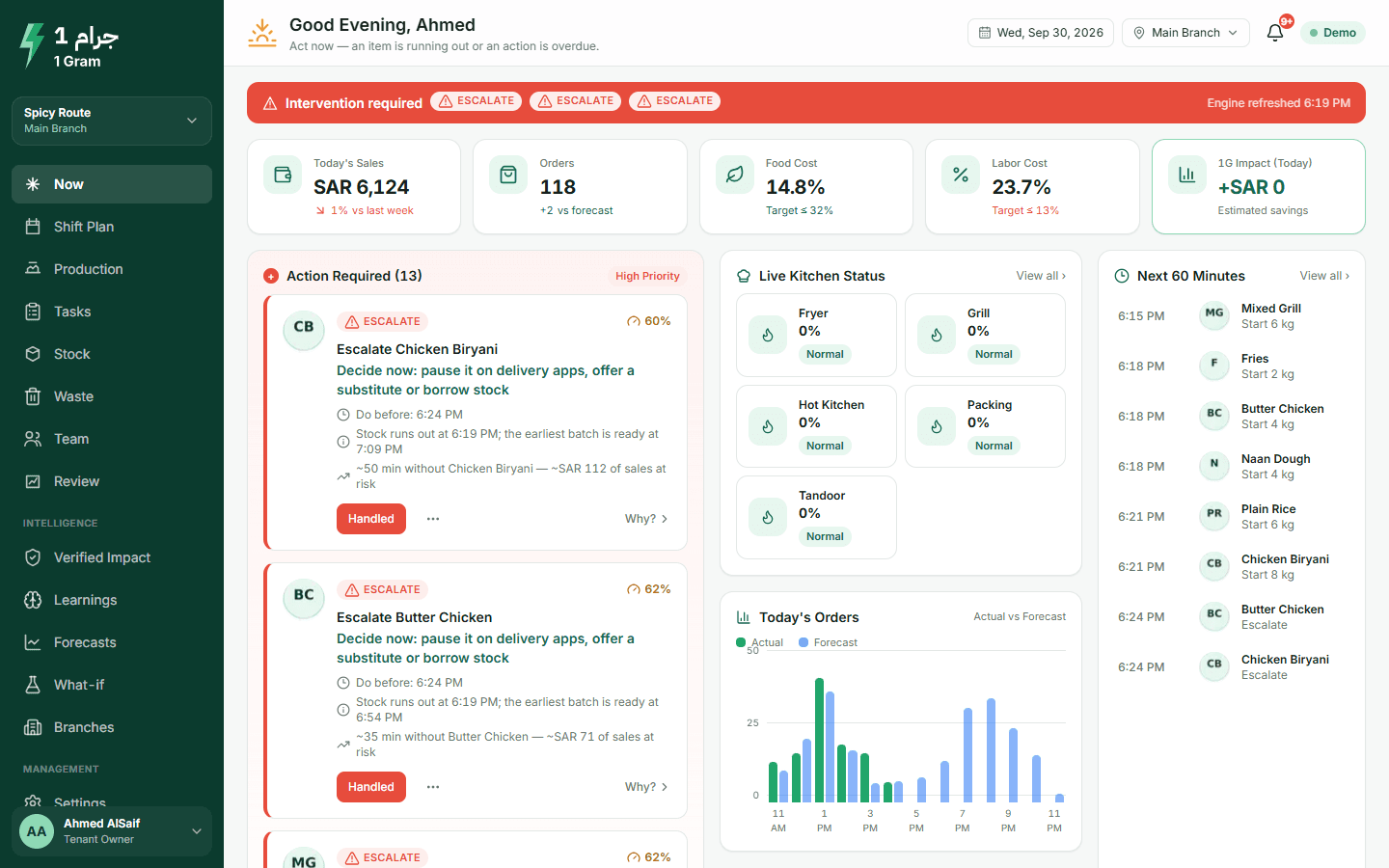
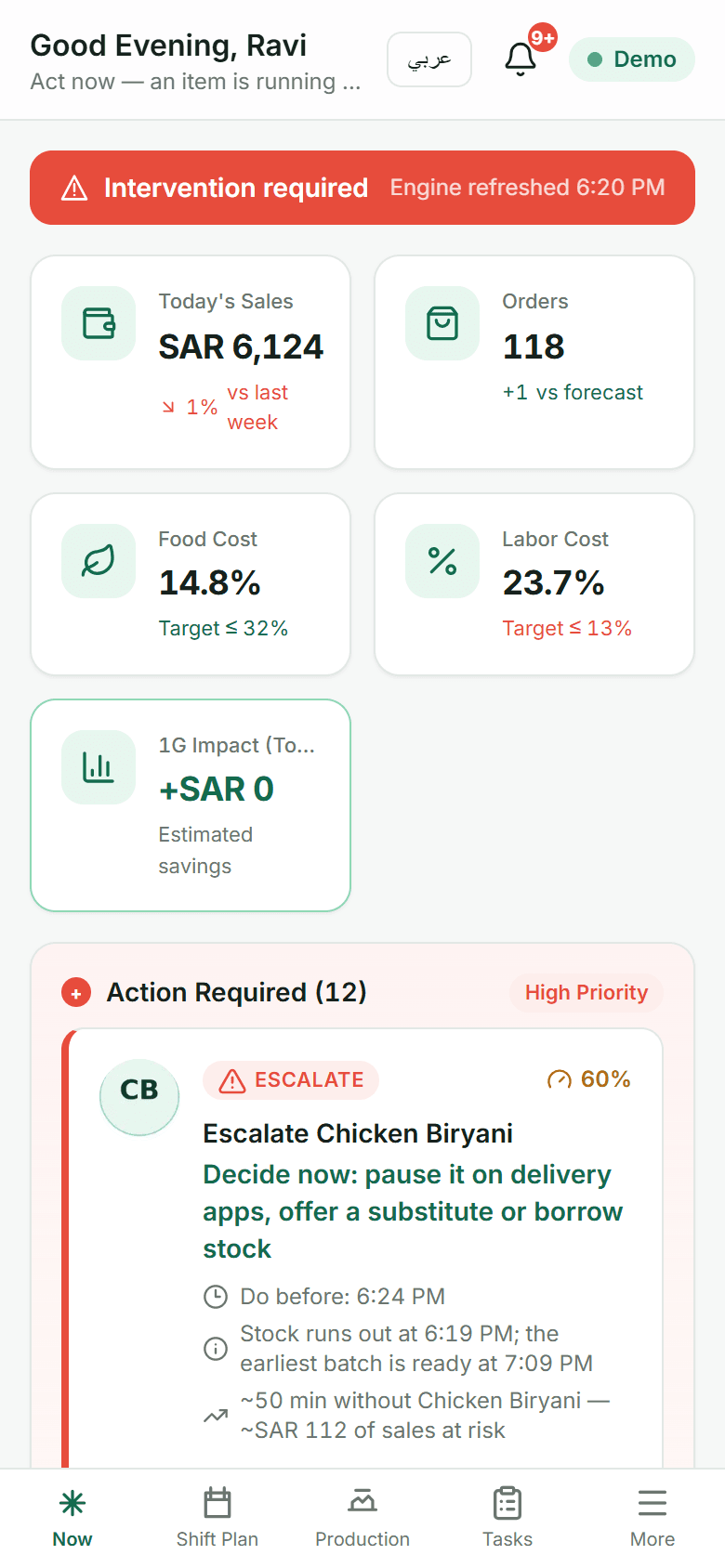
Screens are from a demo restaurant with sample data.
The problem
- Your POS tells you what happened.
- Your inventory tells you what you have.
- Your reports tell you what went wrong.
1 Gram tells you:
What to do now.
What that looks like in a shift
It runs out before the rush
The biryani is gone at 1 pm and the lunch crowd hasn't arrived yet. Every order after that is a lost sale.
A full tray in the bin at closing
The last batch was cooked at the usual size on a quiet night. What's left gets thrown away.
The manager's request starts late
The manager asked for a new batch before the rush. The kitchen started it late, and nobody can say why.
The numbers arrive too late
The manager hears about it after closing. The owner sees food cost at the end of the month, with no idea which branch caused it.
How it works, every shift
See How It Works- 1
Connect
Link Foodics or Odoo, or upload a sales file. Your POS stays as it is.
- 2
Predict
Demand for each prepared item, every 15 minutes, corrected by how fast you are selling today.
- 3
Decide
Start a batch, wait, stop, count, replenish or move a person. Each with its reason and confidence.
- 4
Execute
The team gets the task on a phone or tablet: what, how much and by when.
- 5
Verify
When the action's window closes, the system checks what really happened, in riyals.
- 6
Learn
Patterns that repeat become adjustments for the next shift. A manager approves each one.
One system for the whole shift
Each part runs on the same forecast and the same list of actions.
Production Intelligence
When to start the next batch, and how big it should be.
Read moreInventory Intelligence
Counts, deliveries, transfers and waste, and what the gaps cost.
Read moreLabor Intelligence
Partly availableLoad on each station, and who moves when one gets busy. Scheduling is coming.
Read moreFor Multi-Branch Restaurants
A fair comparison between branches, and red flags in plain words.
Read more
What each person sees
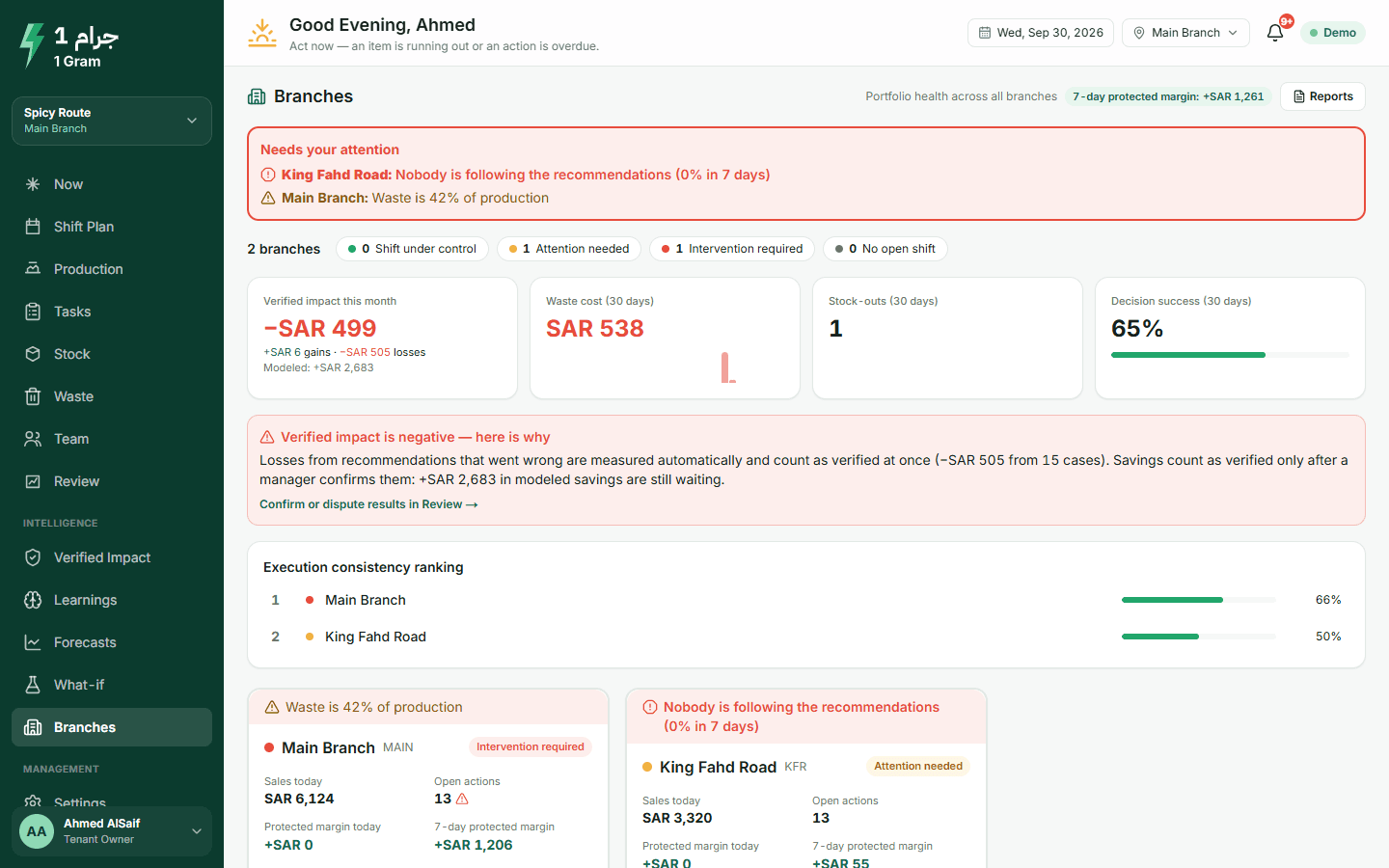
Which branch needs you today
- Branches ranked, with the one that needs you at the top
- A red flag when recommendations are ignored or waste climbs
- A daily summary and a weekly report by e-mail
How savings are counted
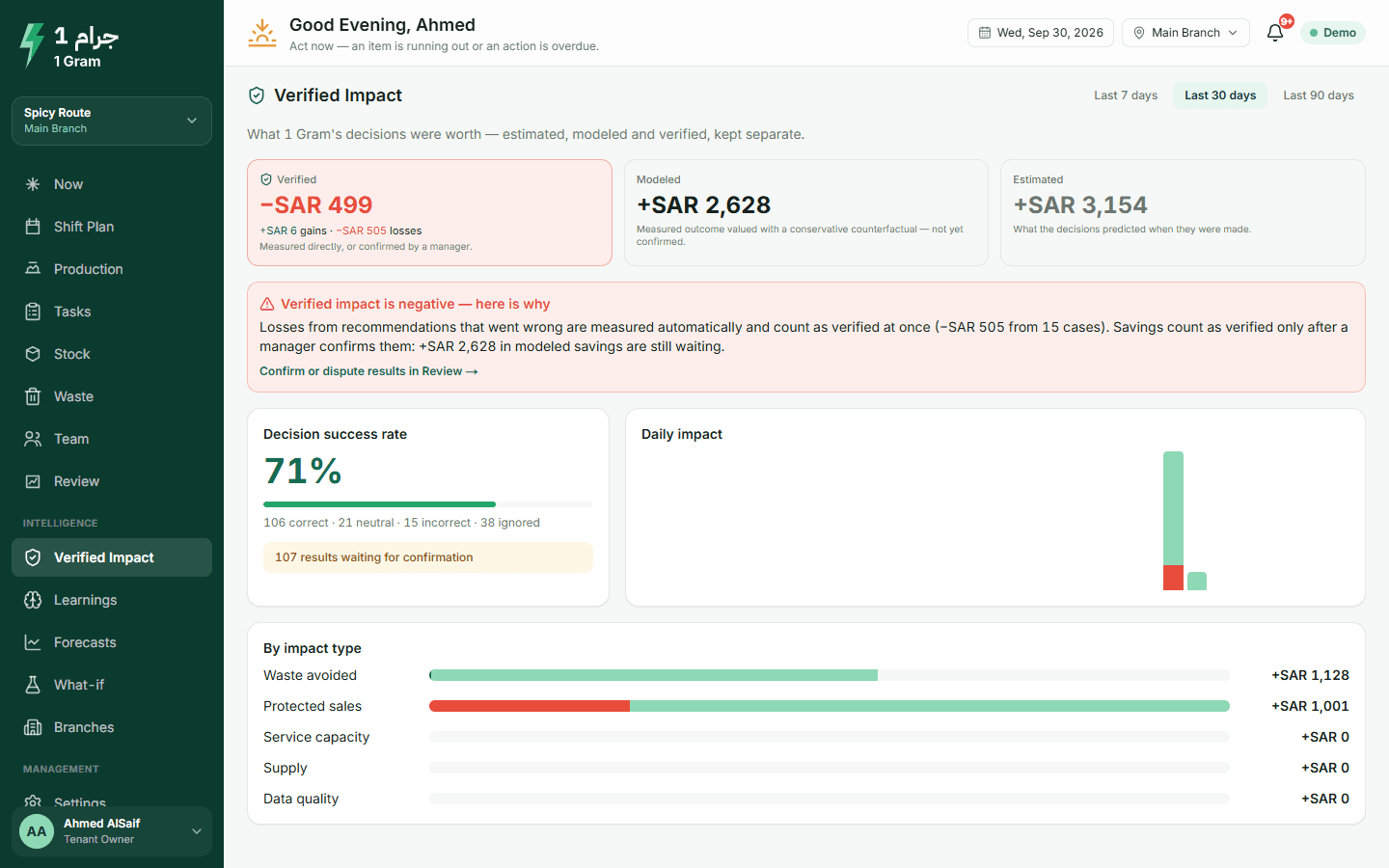
When an action's window closes, the system compares what it expected with what happened and puts a value on it in riyals. Losses, like a stock-out after a wrong recommendation, count straight away.
Savings are different, because they are about something that didn't happen: waste you avoided, or a sale you didn't lose. So a saving stays an estimate until the branch manager confirms it. Gains and losses are shown as two separate numbers and never netted against each other.
The same goes for learning. When the system suggests adjusting a forecast or a safety stock level, a manager approves it first.
Connections and data protection
What it connects to today
- Foodics
- Odoo
- Sales file (CSV)
- Attendance, by webhook
- Kitchen-display ticket times, by webhook
You keep your POS. The system only reads from it.
All connectionsHow your data is protected
- Two-step verification, which you can make mandatory for owners and admins
- Roles per branch, so each person sees only their branch
- An audit log of approvals, setting changes and automated actions
- Each company's data is kept apart inside the database itself
- Hosting in Saudi Arabia is planned and not live yet
Your POS tells you what happened. 1 Gram tells you what to do next.
We are starting with a small group of pilot restaurants. Book a demo and we'll walk you through the system and what a pilot involves for your branches.
See the plansEvery Gram. Every Minute. Every Riyal.